
Facelift. A considered choice.
A facelift repositions facial tissues to address lower-face sagging and changes around the jawline. The extent of the lift, incision pattern and treatment of the neck vary with the operation.
We coordinate enquiries with selected providers. A treating clinician assesses suitability and explains your clinical plan.
- First enquiry
- Free
- Catalogue
- 4 references
- Clinical plan
- Individual assessment
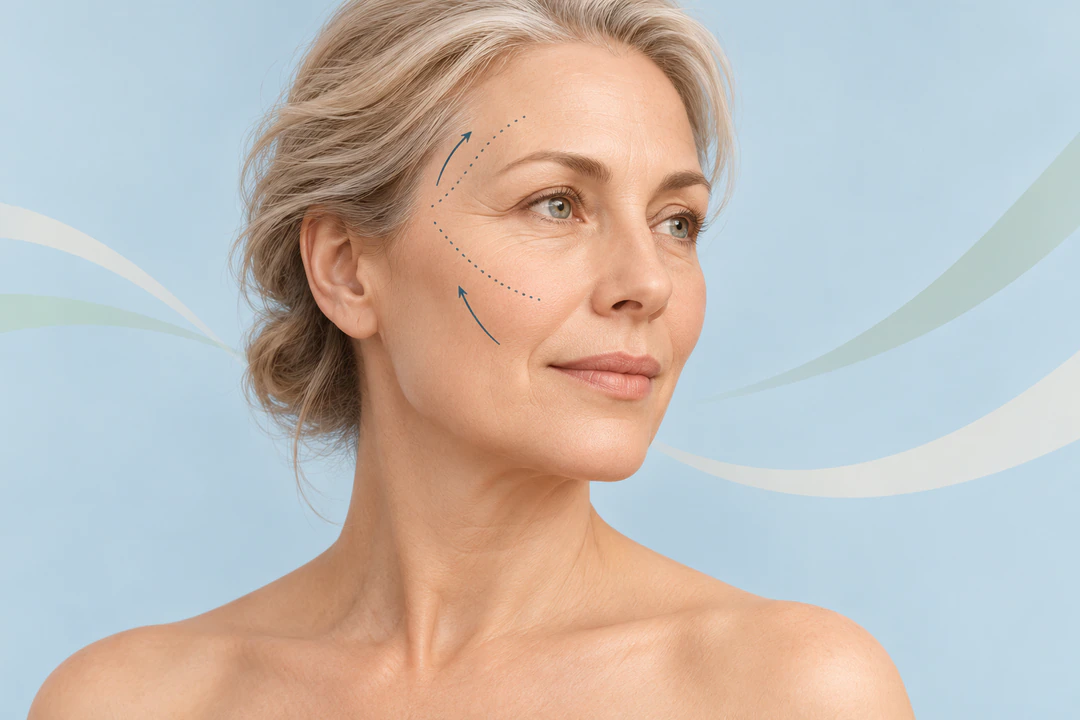
What a facelift can—and cannot—change.
A facelift works on tissue laxity and facial contour rather than treating every sign of ageing. It may address jowls and lower-face looseness; neck treatment depends on the agreed scope. Eyelid surgery, volume replacement and skin-surface treatments are separate procedures. Surgery does not stop future ageing or guarantee a particular appearance.
Facial changes, considered by area
Questions may concern the cheeks, lower face, jawline or neck. Ask which areas the proposed lift includes and what it leaves unchanged. A facelift does not automatically include eyelid surgery or skin treatments.
Describe your priorities and the limits you would be comfortable with. An illustration explains a concept; it cannot predict an individual result.
What an assessment considers.
Discuss the areas that concern you, previous facial treatment and your expectations for the extent of change.
The treating clinician reviews your health, anatomy, goals and alternatives, including no surgery, before explaining whether an operation is appropriate. This page does not determine eligibility or select a technique for you.
Facelift techniques, clearly explained.
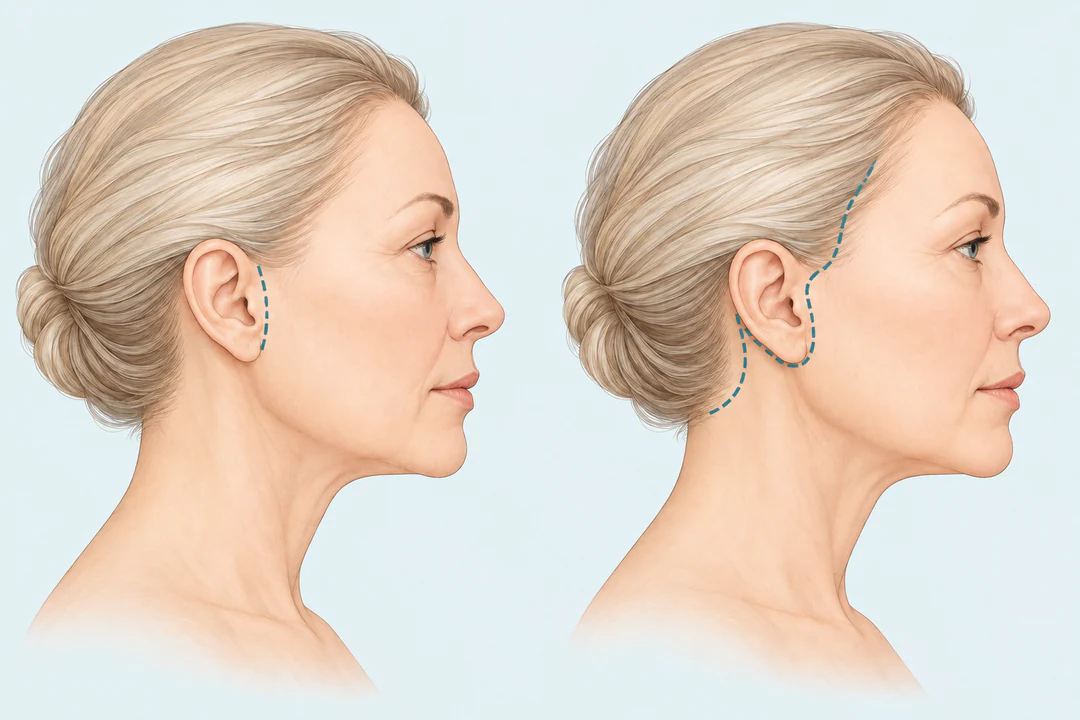
Simplified incision concepts. The drawing does not specify the tissue plane or establish which approach a provider offers.
Traditional facelift
Limited-incision approaches
Suspension references
The treating provider confirms the technique available and appropriate for your circumstances.
The operation, step by step.
- 01
Anaesthesia
General anaesthesia or local anaesthesia with sedation may be used, depending on the planned lift.
- 02
Incisions
Access commonly follows the temple hairline and contours around the ear. Additional access depends on whether the neck is treated.
- 03
Tissue repositioning
Underlying tissues may be lifted or redistributed according to the surgical approach.
- 04
Redraping and closure
The skin is redraped, excess tissue is adjusted and the incisions are closed.
- 05
Dressings and monitoring
Dressings and sometimes drains support early care. The team monitors recovery and explains follow-up.
Facelift: recovery, stage by stage.
These are general milestones, not a fixed schedule. Combined or revision procedures can differ. Follow the treating team’s instructions and confirm follow-up and fitness to fly before booking travel.
- First days
Swelling, bruising and tightness can make the face look different from the intended settled result.
- Week 1
The provider checks healing and any dressings, drains or sutures.
- Weeks 2–4
Many patients need roughly two to four weeks away from work. Bruising can remain visible during the early weeks.
- Following months
Swelling and changes in sensation can continue to settle. A return to daily activities is not the end of healing.
- Around months 6–9
The fuller effect may become clearer over several months. The timing and appearance vary with the extent of surgery and healing.
Preparation & risks. Know what to discuss.
Prepare for your consultation
- Share your goals, relevant health history, allergies, medicines, supplements and previous procedures with the clinician.
- Ask for the provider’s instructions on tests, smoking, medication and fasting. Do not change medication based on this page.
- Confirm who performs the operation, where it takes place and who to contact after discharge.
- Plan assistance, follow-up and flexible travel around the confirmed clinical schedule.
Risks to discuss
Discuss haematoma, infection, slow wound healing, skin loss, scarring, altered sensation and facial nerve weakness, as well as anaesthetic and blood-clot risks.
This is not an exhaustive list. The clinician should explain individual risks and alternatives before consent. Seek urgent medical help for severe or rapidly worsening symptoms, breathing difficulty or heavy bleeding.
Prices & what is included.
References from the supplied price list, not a personalised or all-inclusive quote. Final procedure, materials, anaesthesia, facility, follow-up and travel inclusions must be confirmed in writing. Add-ons are listed separately below.
USD is shown first for comparison, with original CNY references beneath converted amounts. These are not live quotes or a guarantee of availability.
| Procedure | Reference price |
|---|---|
| Mini facelift | ≈ USD 4,143Original: CNY 27,800 |
| Full facelift | ≈ USD 6,975Original: CNY 46,800 |
| Fascial suspension procedure | ≈ USD 3,696Original: CNY 24,800 |
| Mesh suspension procedure | ≈ USD 3,547Original: CNY 23,800 |
This is the current catalogue reference, not a personalised quote.
For aesthetic care, MediBridge coordination is included in the confirmed package, with no separate MediBridge service fee. A physician consultation is separately arranged and quoted.
Request a written breakdown of the procedure, materials, anaesthesia, facility, follow-up and any hotel, transfer or language support. Confirm exclusions and charges for additional care.
Before you decide.
Further patient information: ASPS: facelift (opens in a new tab) · Procedure (opens in a new tab) · Recovery (opens in a new tab) · Risks (opens in a new tab) · NHS: procedure and recovery (opens in a new tab)
Educational references checked 29 October 2026. These sources do not endorse MediBridge or establish the services offered by a particular provider.
From your first question to practical arrangements.
- 01
Start a free enquiry
Tell our coordination team what you are exploring. No complete file is needed to begin.
- 02
Arrange a clinical consultation
Confirm the clinician, consultation format and any separate fee. Ask how to share records securely.
- 03
Review the proposal
Check the operation, provider, total price, inclusions and terms before deciding.
- 04
Confirm travel & follow-up
Agree appointments and practical support around the treating provider’s plan.