
Rhinoplasty. A considered choice.
Start with what you would like to understand about your nose, your options and the practical arrangements for care in China.
We coordinate enquiries with selected providers. Your treating clinician assesses suitability and recommends the clinical plan.
- First enquiry
- Free
- Clinical plan
- Individual assessment
- Travel timing
- Provider confirmed

Your priorities. Your own plan.
Tell the clinician what matters to you: your profile, proportions, previous procedures or concerns about breathing. A reference photograph can help explain a preference, but it cannot establish what is achievable for you.
Ask which changes are appropriate, which alternatives exist and what the proposed operation includes. A website enquiry is not a medical assessment.
Shape, proportion & previous surgery
Questions may concern the bridge, tip, nostrils, facial proportions or a previous operation. If breathing is a concern, describe it separately so it can be clinically assessed. A change in appearance does not establish an improvement in breathing.
Describe your priorities and the limits you would be comfortable with. An illustration explains a concept; it cannot predict an individual result.
What an assessment considers.
Discuss your nasal anatomy, breathing symptoms, previous surgery or injury, and the change you hope to achieve.
The treating clinician reviews your health, anatomy, goals and alternatives, including no surgery, before explaining whether an operation is appropriate. This page does not determine eligibility or select a technique for you.
Rhinoplasty techniques, clearly explained.
Open and closed describe how the surgeon accesses the nasal framework. Neither is automatically right for everyone.
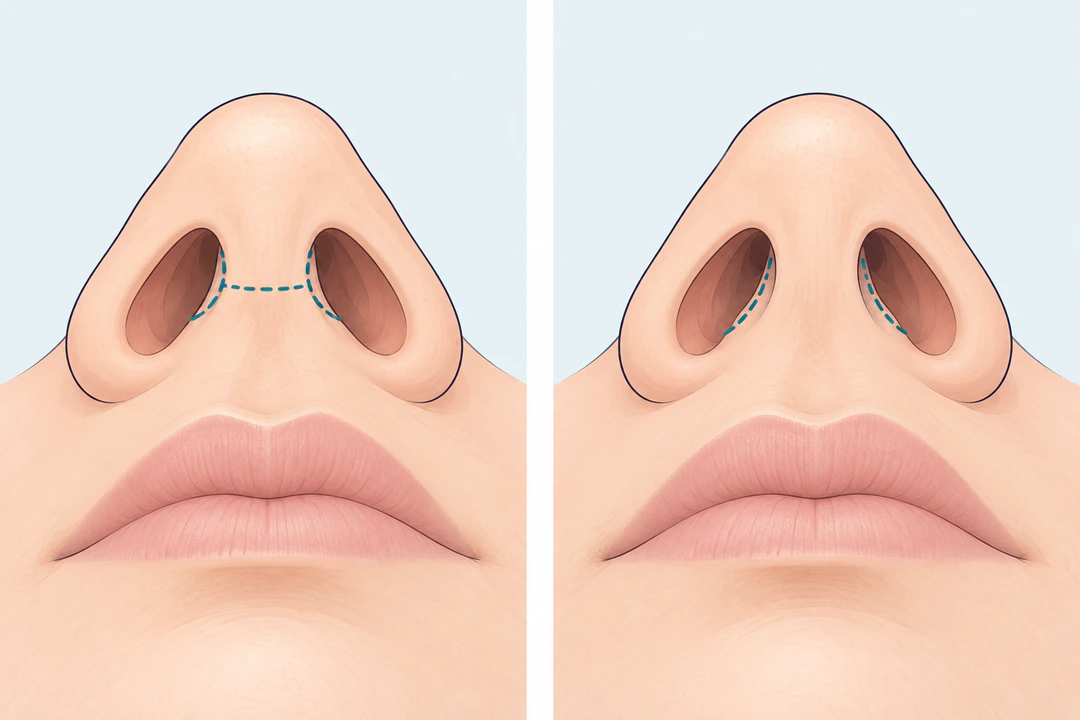
Open rhinoplasty
Closed rhinoplasty
Simplified illustrations of access points, not a surgical plan. Source: ASPS procedure overview (opens in a new tab).
The operation, step by step.
A patient-level overview. The actual sequence depends on the agreed operation.
- 01
Anaesthesia
The anaesthesia team selects the appropriate approach, which may involve general anaesthesia or sedation.
- 02
Access
The surgeon uses the agreed open or closed route to reach the bone and cartilage.
- 03
Reshaping & support
Bone or cartilage may be reshaped; cartilage grafts may add support. Septal correction is included only when indicated and agreed.
- 04
Closure
The tissues are repositioned and incisions closed.
- 05
Early protection
Splints or dressings may support the nose while healing begins. The clinical team gives individual care and review instructions.
Source: American Society of Plastic Surgeons (opens in a new tab)
Rhinoplasty: recovery week by week.
What you may notice as healing progresses. Timing varies with the operation and the individual; your treating team confirms your activity and travel plan.
- Day 1
Your nose may feel blocked, sore and swollen, with bruising around the eyes. An external splint and sometimes internal supports protect the area. Your care team explains what to expect and how to manage discomfort.
- Week 1
An early review checks healing. The splint and non-dissolving stitches may be removed around this time. Swelling can still obscure the shape, so this is too early to judge the result.
- Weeks 2–3
Bruising and swelling may become less noticeable. Some people return to work after roughly two weeks, depending on their job and recovery. The nose can still feel stiff or numb.
- Weeks 4–6
Your surgeon may clear a gradual return to more strenuous activity. Activities that could injure the nose need separate advice; feeling better does not mean healing is complete.
- Month 3
The appearance may still be changing. Residual swelling can conceal finer contours, and the pace of settling differs between people. Follow-up helps you understand how your own recovery is progressing.
- Around month 12
The contour may take up to a year to refine. Swelling can fluctuate during that time, including being more noticeable in the morning. This is a general milestone rather than a guaranteed finishing date.
General timing: NHS rhinoplasty guide (opens in a new tab). Longer-term healing: ASPS recovery guide (opens in a new tab).
Preparation & risks. Know what to discuss.
Ask your surgeon about time in China, review appointments, daily activities and fitness to fly. Keep travel plans flexible until the clinical schedule is confirmed. Follow the provider’s preparation instructions; do not change medication based on a website.
A clear scope. Before you commit.
Based on six listed ear- or rib-cartilage + implant rhinoplasty options. Focused procedures and removals are separate. Final scope, materials and package inclusions require a written provider quote.
Catalogue prices are references, not personalised quotes. For aesthetic care, MediBridge coordination is included in the confirmed package, with no separate MediBridge service fee. A physician consultation is quoted separately.
Request written confirmation of the procedure, materials, anaesthesia, facility fees, follow-up and any hotel, transfer or language support. Ask how changes or additional care would be charged.
Compare existing reference pricesExplore the nose references.
Cartilage & implant options
Focused contour procedures
Removal procedures
Before you decide.
From a question to an agreed next step.
- 01
Tell us what you are exploring
Start with a free service enquiry. Ask how relevant information can be shared securely.
- 02
Arrange clinical assessment
Confirm the proposed clinician, consultation format, required materials and any separate consultation fee.
- 03
Review the written proposal
Understand the procedure, provider, package inclusions, exclusions and payment terms before deciding.
- 04
Confirm travel and follow-up
Agree appointment dates, local support and follow-up arrangements around the treating provider’s instructions.